How Much Do Braces Cost in New Jersey?
How much do braces cost in New Jersey? Metal braces average $7,283 in New Jersey, which is $940 above the national average of $6,343, about 15 percent more. That number is a measured published average from the Synchrony CareCredit study. It reflects the practices sampled in New Jersey, so treat it as a real starting point, not a cost of living ranking.
Amount | |
New Jersey metal braces average | $7,283 |
National metal braces average | $6,343 |
Difference | $940 more, about 15 percent |
This is a survey average from the practices sampled in New Jersey, not a cost of living ranking. Prices last checked: October 2026.
New Jersey Braces Calculator
Want a number for your own case? The calculator is set to New Jersey. Pick your brace type and how complex your case is, and it will estimate braces cost in New Jersey for you.
Your estimate
Estimate only, based on published cost-study data (see how we calculate, below). Your orthodontist's quote depends on your case. This is not medical or financial advice.
How Much Do Braces Cost in New Jersey by Type?
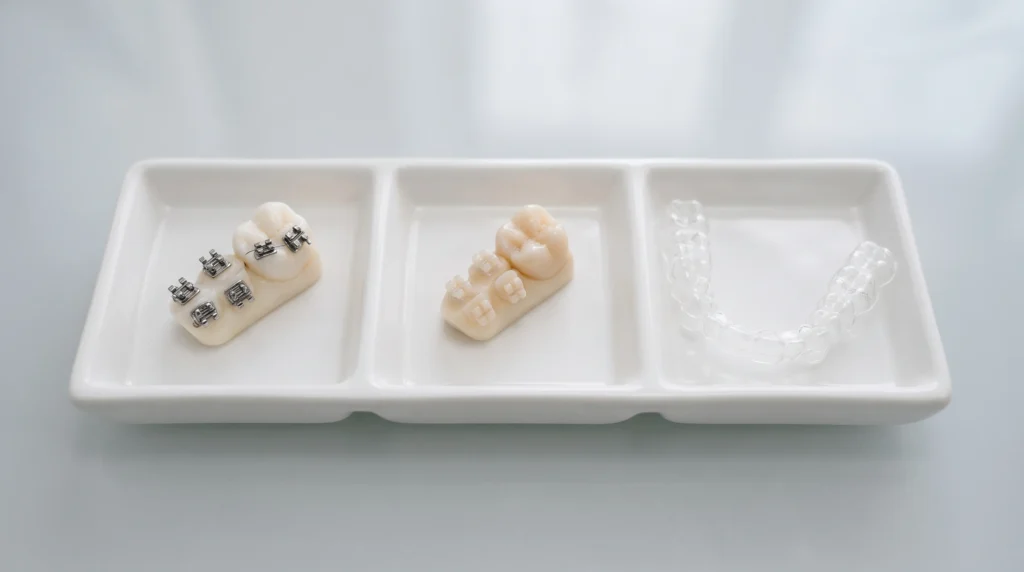
Type is the biggest driver of price in New Jersey. Metal braces average $7,283 and clear aligners average $4,661, both measured published figures for the state. Ceramic and lingual braces are shown as adjusted estimates, explained below the table. Each New Jersey number sits beside the national average so you can see the gap.
Brace type | New Jersey | National average | How we got the New Jersey figure |
Metal braces | $7,283 | $6,343 | Published state average |
Ceramic braces | $6,700 | $5,834 | Adjusted estimate, see note |
Lingual braces | $10,590 | $9,221 | Adjusted estimate, see note |
Clear aligners | $4,661 | $5,108 | Published state average |
Two of these numbers are estimates, and we will not pretend otherwise. The ceramic figure of $6,700 and the lingual figure of $10,590 are the national averages adjusted by New Jersey’s published metal braces cost level in the Synchrony CareCredit study, not surveyed local prices. A local quote can sit above or below them.
The metal and clear aligner figures are different, because they are measured published state averages. Metal braces come from the Synchrony CareCredit study, and the clear aligner figure comes from CareCredit’s published state table for aligner treatment.
Sources: Synchrony CareCredit Average Procedural Cost Study for the metal braces state average and the national averages; CareCredit’s published state table for the clear aligner figure. Prices last checked: October 2026.
Why Braces Prices Vary Inside New Jersey
The state average is a starting point, not your quote. Inside New Jersey, four things move the price: how complex your case is, how long treatment runs, the type of provider you choose, and where in the state you are. Of these, your case usually matters most.
Case complexity.
A small gap is a quick fix, while a severe bite takes more visits and more materials. Complexity moves a quote more than anything else on this list. Two people in the same town can get very different numbers for this reason.
Treatment length.
A 12 month plan costs less than a 24 month one, because much of the fee pays for the regular visits. The longer the case, the higher the total.
Provider type.
A board certified orthodontist may charge more than a general dentist offering braces. The fee often reflects training and experience, so ask what is included before you compare.
North Jersey versus South Jersey.
A practice in the North Jersey commuter belt near New York City carries higher overhead than one in South Jersey, and that can show up in the fee. No source publishes city level averages for New Jersey, so this page prints no city price. Prices do vary inside the state, but case complexity moves a quote more than the part of New Jersey you live in.
Paying for Braces in New Jersey
You have three main ways to lower the cost in New Jersey: private insurance, Medicaid for eligible children, and the state’s dental school. Private plans pay a share up to a cap, NJ FamilyCare covers medically necessary cases for children, and Rutgers treats the public at lower, published fees. Here is each one.

Private insurance
Plans that include orthodontics commonly pay 50 percent of the cost, capped by a lifetime maximum of $1,000 to $3,000 that does not reset each year. Source: FAIR Health. The cap, not the percentage, usually decides what you save. For the full treatment, see New Jersey payment plans and coverage options and paying for braces in New Jersey with insurance or Medicaid.
NJ FamilyCare
In New Jersey, Medicaid is NJ FamilyCare. It covers braces for children only, with the plan criteria grid covering ages 8 to 21, and only for handicapping malocclusions. Prior authorization is required. Braces for adults are not covered.
Two scoring facts are on record, and we carry both rather than blend them into one number. The state regulation, N.J.A.C. 10:56-2.15, names a Salzmann based Handicapping Malocclusion Assessment System, recorded on Form FD-10, with a threshold of 24 points. Under current plan criteria, Liberty Dental Plan in 2025, cases are instead scored on the HLD Index, New Jersey modification, and approved at 26 points under current plan criteria, or with an automatic qualifying condition.
For the full rules and how to apply, see does Medicaid cover braces and the Medicaid orthodontic coverage rules.
New Jersey dental school
Rutgers School of Dental Medicine in Newark is the state’s only dental school, and its graduate orthodontics clinic publishes its fees. Care is given by residents under faculty supervision, which is why the fees sit below private practice.
Patient | Published full treatment fee |
Adolescents | $3,000 to $3,300 |
Adults | $3,600 to $3,800 |
Frequently Asked Questions
Ready for your own number? The tool is set to New Jersey. Add your brace type and how complex your case is to see your range.
Keep Exploring
Want the bigger picture or another state? Start with how much braces cost in the US to compare New Jersey to the national average, or see braces costs in all 50 states to see another state.
The figures here are estimates and published averages. The metal and clear aligner numbers are measured published state figures, while the ceramic and lingual numbers are explained estimates, not local quotes. Your real price comes from a consultation with an orthodontist who can see your teeth. This page is not dental or financial advice.