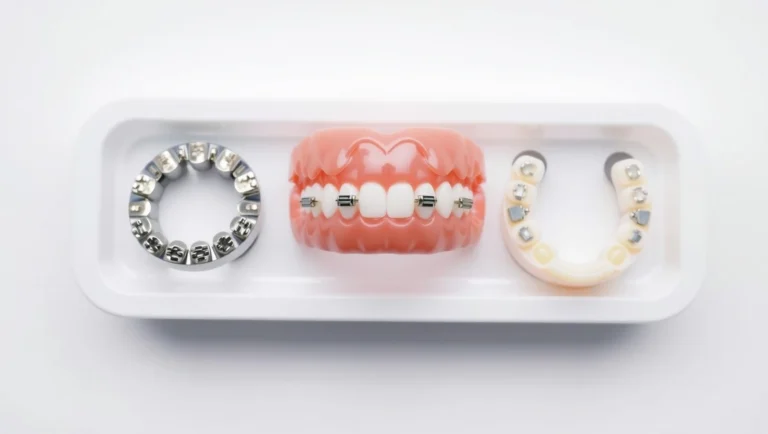
How Much Do Braces Cost in 2026?

How much do braces cost depends on the type you choose. In 2026 the national average runs from $5,108 for clear aligners to $9,221 for lingual braces. Traditional metal braces average $6,343. Your final price shifts with your state, your case, and whether insurance pays a share. The full ranges are below.
Brace type | Typical range | National average |
Metal braces | $2,500 to $10,000 | $6,343 |
Ceramic (clear) braces | $4,480 to $11,312 | $5,834 |
Lingual braces (behind the teeth) | $7,321 to $17,411 | $9,221 |
Clear aligners | $1,800 to $8,100 | $5,108 |
The $1,800 low end for clear aligners covers limited and direct to consumer cases, not a full treatment plan. Figures come from the Synchrony CareCredit study described in the sources below. Prices last checked: October 2026.
Where These Prices Come From
Every price on this page traces to one study: the Synchrony CareCredit Average Procedural Cost Study, carried out by ASQ360° Market Research across the 50 states and DC in 2023 to 2024. Insurance facts are named where they appear. No figure on this page comes from a practice’s own price list, including ours, because this site sells nothing and books no appointments. That independence is why the numbers here are worth trusting.
Want a number for your own case, not a national average? The calculator asks for your state, your brace type, and how complex your case is, then gives you an estimate in seconds.
How Much Do Braces Cost by Type?
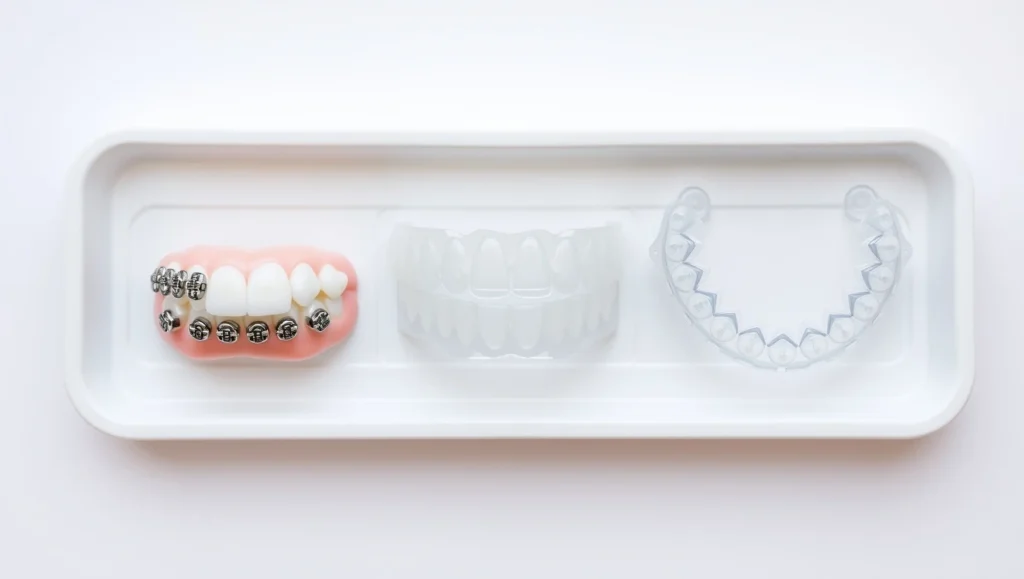
Brace type is the biggest driver of price. By national average, clear aligners are lowest at $5,108, though that low end covers limited cases, not full treatment. Ceramic braces average $5,834, just below metal braces at $6,343, which surprises most people. Metal braces are the most widely offered option and treat the widest range of cases, while lingual braces cost the most.
Brace type | What it is | Typical range | National average |
Metal braces | Stainless steel brackets and wires, the classic option | $2,500 to $10,000 | $6,343 |
Ceramic (clear) braces | Tooth colored brackets that blend in | $4,480 to $11,312 | $5,834 |
Lingual braces | Fixed to the back of the teeth, hidden from the front | $7,321 to $17,411 | $9,221 |
Clear aligners | Removable trays swapped every week or two | $1,800 to $8,100 | $5,108 |
By national average, clear aligners are the lowest at $5,108, and ceramic braces at $5,834 come in just below metal braces at $6,343. That order surprises people who expect metal to be the cheapest. The clear aligner low end of $1,800 reflects limited and direct to consumer treatment, not a full plan, so most full aligner cases cost far more. Metal braces stay the most widely offered type and treat the widest range of cases, including complex ones.
Ceramic braces work like metal braces but use tooth colored brackets, which is why they average a little less in this study while still topping out above $11,000 in hard cases. Lingual braces cost the most because each bracket is custom made and placement needs special training.
To see the options next to each other in detail, compare metal, ceramic and lingual braces costs on the type guide.
Source: Synchrony CareCredit Average Procedural Cost Study, ASQ360° research, 2023 to 2024, published at carecredit.com. Prices last checked: October 2026.
Why Two Quotes for Braces Can Look So Different
Two people can get very different quotes for the same smile. Three things drive the gap: how complex the case is, how long treatment runs, and where the practice is. Understanding these three helps you read a quote and spot what you are paying for.
Case complexity
A small gap between two teeth is a simple fix. A severe crossbite or an impacted tooth is not. Complex cases need more visits, more time in the chair, and more materials. That is why the ranges in the table above are so wide.
Treatment length
Most braces are worn for 12 to 24 months. A shorter plan costs less than a long one, because much of the fee pays for the regular visits across treatment. Keeping every appointment and following instructions helps avoid an unplanned extension.
Location
Where you live changes the price. A practice in a high cost city carries higher rent and higher wages, and that shows up in the fee. This is why the same braces cost more in one state than another, which the state table below makes clear.
Braces Cost by State
Braces cost more in some states than others. The averages below are for metal braces, the most common type. They come from a national study that surveyed real procedure prices in every state. Use your state as a starting point, then run the calculator for a number that fits your own case.

State | Average metal braces cost |
Alabama | $5,280 |
Alaska | $6,082 |
Arizona | $6,724 |
Arkansas | $6,043 |
$6,087 | |
Colorado | $6,892 |
Connecticut | $5,927 |
Delaware | $5,946 |
District of Columbia | $5,712 |
$6,219 | |
Georgia | $5,786 |
Hawaii | $6,969 |
Idaho | $6,535 |
Illinois | $6,309 |
Indiana | $4,767 |
Iowa | $6,129 |
Kansas | $7,735 |
Kentucky | $5,683 |
Louisiana | $7,509 |
Maine | $5,785 |
Maryland | $6,278 |
Massachusetts | $7,007 |
Michigan | $7,193 |
Minnesota | $6,090 |
Mississippi | $6,362 |
Missouri | $7,280 |
Montana | $6,211 |
Nebraska | $5,725 |
Nevada | $8,350 |
New Hampshire | $6,157 |
$7,283 | |
New Mexico | $6,783 |
$5,807 | |
North Carolina | $6,716 |
North Dakota | $6,592 |
Ohio | $7,127 |
Oklahoma | $6,940 |
Oregon | $6,713 |
Pennsylvania | $5,966 |
Rhode Island | $6,481 |
South Carolina | $6,127 |
South Dakota | $6,670 |
Tennessee | $5,901 |
$6,504 | |
Utah | $5,853 |
Vermont | $5,704 |
Virginia | $6,151 |
Washington | $6,370 |
West Virginia | $6,069 |
Wisconsin | $6,046 |
Wyoming | $5,363 |
The national average for metal braces is $6,343. Across all 50 states and DC, the same study puts the lowest average in Indiana at $4,767 and the highest in Nevada at $8,350.
One thing to keep in mind. These are procedure survey averages from the practices sampled in each state, not a ranking of how expensive a state is to live in. That is why a few numbers surprise people, such as Nevada sitting at the top and some big coastal states sitting below states you might expect to be cheaper. Treat each figure as a starting point for that state, not a rule.
Click your state above for local detail, or get a price estimate for your state in the calculator.
Source: Synchrony CareCredit Average Procedural Cost Study, ASQ360° research, 2023 to 2024, published at carecredit.com. Prices last checked: October 2026.
Why Published Averages for Braces Disagree
You will see different national averages for braces on different sites, and both can be honest. Our study puts metal braces at a $6,343 average. ValuePenguin, using a different method, reports $5,991 overall. The gap comes from what each one measures.
Our figures come from the Synchrony CareCredit study, which is a procedural cost study. It measures what procedures actually cost across practices. ValuePenguin works from the American Dental Association survey of dental fees, which covers more than 1,000 dentists and records the fees they list. A fee survey and a cost study ask different questions, so two honest sources land on different numbers.
We use the Synchrony figures on this page for one reason. It is the only one of the two that also publishes an average for every state, which lets us show you a number for where you live, not just a national one.
Do Adults Pay More for Braces Than Teens?
The braces themselves cost the same for an adult and a teen. The hardware and the chair time do not change with age. What changes is coverage. Many dental plans only pay for orthodontics for dependents under 19, so adults more often pay the full fee out of pocket.

This is the part that catches adults off guard. The sticker price is not higher, but the help is smaller. A teen on a family plan may get a share paid by insurance. An adult on the same plan may get nothing toward orthodontics, because the benefit stops at 19.
So when you compare an adult quote with a teen quote, the gap you feel is usually a coverage gap, not a price gap. For the full picture of what insurance pays and who qualifies, see what braces cost with and without insurance.
Source for the under 19 coverage pattern: FAIR Health.
Braces Cost With and Without Insurance
Most dental plans treat braces as a separate benefit with a lifetime cap, not a yearly one. Plans that include orthodontics commonly pay half the cost, up to a lifetime maximum of $1,000 to $3,000. On a $6,343 metal braces fee, a $1,500 cap leaves you paying $4,843. Here is how that works.
Step | Amount |
Full fee | $6,343 |
Plan pays 50 percent | would be $3,172 |
But the lifetime cap limits it to | $1,500 |
So you pay | $4,843 |
The cap is the catch. A plan may advertise 50 percent coverage, but the separate lifetime maximum of $1,000 to $3,000 sets the real limit, and it does not reset each year.
Actual payouts tend to be smaller still. In the largest published sample, 112,243 insured US patients received a mean benefit of $1,772 toward braces in 2021. So the real world help is close to a single lifetime cap, not half the fee.
This is a summary. For the full treatment, including how to read a policy and set up a payment plan, see what braces cost with and without insurance.
Sources: FAIR Health; CareCredit; Delta Dental of Washington plan terms; Align Technology citing OrthoFi verification data. Prices last checked: October 2026.
Ways to Pay Less for Braces
You have more than one way to lower the bill. Spread the fee over monthly payments, use a dental school for a lower price, or check Medicaid or CHIP if the patient is a child. Each route is a doorway. The full detail lives on the insurance guide.

Monthly payment plans
Most orthodontists no longer ask for the full fee up front. The common pattern is a down payment, then monthly payments across treatment, often 12 to 24 months, and often interest free on in house plans. Ask what the down payment is and what the monthly figure works out to.
Dental schools
Orthodontic training clinics treat the public at a lower price, with care given by residents under faculty supervision. Treatment can run longer, since the clinic follows an academic calendar. No national fee is published, so ask the clinic directly.
Medicaid and CHIP for children
For children, Medicaid or CHIP may cover braces when treatment is medically necessary, not cosmetic. Rules and approval vary by state. We cover who qualifies and how to apply on the page about does Medicaid cover braces.
For the full treatment of coverage and payment, see insurance, Medicaid and payment plans explained.
Source for the payment plan pattern: AAO (aaoinfo.org).
How to Lower the Quote You Are Given
The quote you are handed is often a starting point, not a fixed price. Most practices are privately owned and set their own fees. A few plain steps can bring the number down, or at least tell you whether it is fair.
Ask for the full fee in writing, itemised. Get every line on paper: the braces, the visits, the retainers, and anything billed separately. A written, itemised quote is the only way to compare two practices fairly.
Get a second quote and use it. Book a consultation with another practice, most of which are free, then take that quote back to the practice you prefer. Ask, in plain words, whether they can match it.
Ask about paying in full. It is commonly reported that paying the whole fee up front can earn a discount. It costs nothing to ask whether the practice offers one.
Check what is included before you compare. A lower quote can look cheaper only because it leaves out retainers or records. Compare the total after those extras, not the headline number.
For a quick version of this, see the negotiation question in the FAQ below.
Frequently Asked Questions
Sources for this section: Synchrony CareCredit study for the extra item costs; AAO for the payment and consultation pattern. Prices last checked: October 2026.
Sources
Every price on this page comes from a named source. Here they are in full.
The type and state averages come from the Synchrony CareCredit Average Procedural Cost Study, carried out by ASQ360° Market Research across the 50 states and the District of Columbia in 2023 to 2024, and published at carecredit.com.
The insurance figures come from FAIR Health, from CareCredit, and from Delta Dental of Washington plan terms, which together describe how orthodontic benefits, lifetime maximums and the under 19 limit work.
The figure for what insured patients actually received, a mean benefit of $1,772 across 112,243 patients in 2021, comes from Align Technology citing OrthoFi verification data.
The payment plan pattern and the note on free or low cost first consultations come from the American Association of Orthodontists at aaoinfo.org. The AAO does not publish a national fee, so no dollar average on this page is attributed to it.
Prices last checked: October 2026.
Now you know the averages. See what your own case looks like with your state, your brace type, and how complex your case is.
The figures on this page are estimates built from published averages. They are a guide, not a quote. Your real price comes from a consultation with an orthodontist who can see your teeth. This page is not dental or financial advice.